
Musicians Jerry Garcia - electric guitar (lead), vocals Bill Kreutzmann - drums, perc Bob Weir - electric guitar (rhythm), vocals Keith Godchaux - keyboards Phil Lesh - electric bass, vocals
Set 1: Bertha , Me And My Uncle , Sugaree , Jack Straw , Tennessee Jed , El Paso , Loser , Playing In The Band , Cumberland Blues , Black Peter , Beat It On Down The Line , Deal , Mexicali Blues , Sing Me Back Home , One More Saturday Night Set 2: Ramble On Rose , Me And Bobby McGee , Cryptical Envelopment > Drums > The Other One > Cryptical Envelopment > Comes A Time , Sugar Magnolia , Brown Eyed Women , Not Fade Away > Goin' Down The Road Feelin' Bad > Not Fade Away
November 6-7, 1971: Harding Theatre, SF
LIVE DEAD AT THE HARDING
"...come one, come all, we're gonna have a ball Down at the function at the junction." F. "Shorty" Long/E. Holland
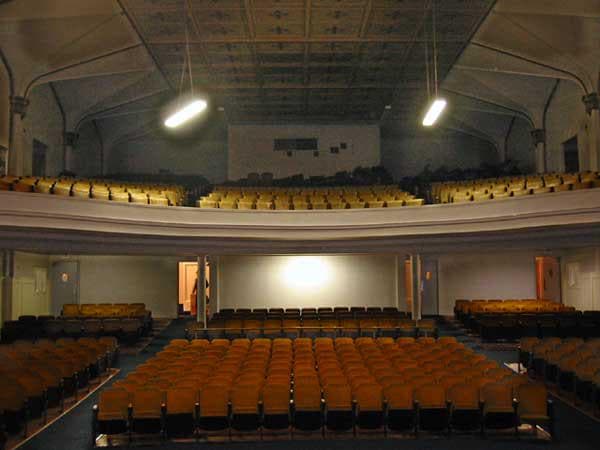
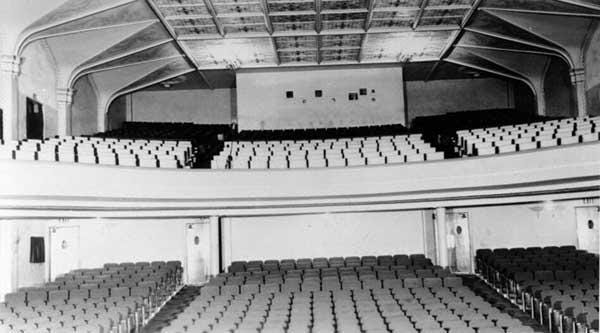
San Francisco's Harding Theatre, at 616 Divisadero St., hasn't been noted for staging any notable musical performances, rock, soul, or otherwise. Oh yes, Curtis Mayfield and Hugh Masakela both made appearances on the small stage there, but that's kinda what you'd expect from a tiny, community-oriented theatre in the primarily black Fillmore district. It's an absolutely wonderful little place. There are old, wood-paneled doors; a big, weathered marquee outside; an airy lobby with a nice rug; very passable acoustics in a fairly unadorned theater proper; and maybe 500 roomy seats on the ground floor. Upstairs, in the balcony, are perhaps 300 huge, plush seats cum sofas sporting such niceties as double legroom, padded armrests and seatbacks (to rest one's head), and a perfect view of the stage from every angle. You can feel pleasantly comfortable, and intimate, with whomever is on the stage at the Harding. The worst seat in the house is no more than a hundred feet away. A lot of us, you see, still can't quite believe that the Grateful Dead (Lord-A-Mercy!) played the Harding this past Saturday and Sunday nights. Essentially it's like bopping down to the local Bijou to catch the Stones. But the Dead simply called it "a little party for our friends." And for the friends who couldn't make it, the exceedingly wonderful KSFX (103.7 on the FM dial) broadcast the Sunday night gig live.
Admittedly the regularly scheduled gatherings at Winterland are attended by the devoted, but it was the truly faithful who made it to the Harding last weekend. It was a gathering right out of the old Haight, five years before. Older faces, gentled faces. Faithful friends. "It's like walking into a huge party," exclaimed Uncle Bob. And so it was. Why, there was Big Mac, Erwin Clair, Funk and Tomaso (not to mention Mr. Mellow, C. Mel Chewey and Robbie Sue) and Stony Ralph Brown and the Boys. It was so good to be back together! One still tends, you see, to associate the Dead with the great assemblings of the masses at the Fillmore, and Winterland. And quite rightly, for they synthesized more of the memorable nights there than any other group, with the possible exception of the Airplane. Unfortunately, one could never feel entirely comfortable, in a physical sense, at the latter two; once everybody pressed forward you could always find room to sit on the floor, but that's exactly what it was - sitting on the floor. For the first time in living memory, San Franciscans and their friends who had been weaned on rock concerts without seats could sit back in pure physical comfort and absorb their Dead. This is not to say that the folks couldn't get up and "truck," for there was plenty of space for that down front or in front of your seat, or even on top of your seat, but there is something to be said for the pleasure of lounging back.
It would have been enough (as the old Jewish Passover song goes) that the Dead re-affirmed that they are the Great American Band, the greatest and most powerful rock-and-roll band alive today. It would have been enough that the Dead played for four-and-one-half hours on both nights (and absolutely nobody plays four-and-one-half hours anymore) and only charged Three Dollars ($3.00). It would have been enough that technically and musically they were tight, drivin', cookin' as always, and played most of the favorite tunes superbly well. It would have been enough to know that some friend was probably making a tape off KSFX of the whole thing. It would have been enough that the crowd was typically warm and friendly and well-stoked. But the Dead at the little Harding? That combination was almost too much to take.
The Dead had been, for several months, on a long road tour through Texas and the Southwest. Probably the last time they played in the Bay Area was the closing of the Fillmore West, when they were tired and feeling hassled. Pigpen had not accompanied them; he is still recuperating from liver maladies. But Keith Godcheaux (formerly with Dave Mason) filled in superbly at the concert on keyboards. Although it was assumed that they wouldn't be back in town till Thanksgiving, the Dead family decided to rent out the Harding for a two-night "party." It was cheaply acquired, small, and it gave them the chance to do a live broadcast, without the hassles of Winterland, KSAN, and Bill Graham. Rock Scully, the Dead's manager, contacted Eric Christensen of KSFX, the ABC-affiliated station that, along with WPLJ in New York, has been returning a measure of the old-time greatness to rock radio. They had only two days to set up the equipment, and although the monitors cut out several times and the signal was sometimes weak, the quality of the broadcast and the music was sensational. (KSFX, by the way, intends to air a live B.B. King broadcast recorded in New York, on Thanksgiving eve.)
Just as their memorable four-night gig at the Fillmore West two summers ago ushered in the era of "Workingman's Dead" and "American Beauty," hallmarked by intricate harmony and a mellow country influence, this two-day gig at the Harding marked their transition into good ol' rock n' roll. They're a band you not only come to see and hear, but also to dance and jump and smile to. A band; not just a group. But why don't people go to concerts to dance anymore? Dead freaks, for instance, go to concerts fully expecting to shake a leg. "Getting up to truck" is the way it's usually put. But today that's something unique in the rock world. For one thing, the closing of the two Fillmores dealt a severe blow to the small rock concert scene. Now there's only Winterland, or the S.F. Civic, or, God forbid, the Oakland Coliseum. In New York, there are only overpriced clubs, over-sold Howard Stein rip-offs, and Madison Square Garden. But there hasn't been an emphasis on dancing since the early days of rock 'n roll. Probably it goes back even further, back to the great dance bands of the '40's and '50's. Just read the Autobiography of Malcolm X, wherein you'll find colorful descriptions of the emotional frenzy and excitement generated by the Kings of "Swing" in the East coast ballrooms. Much of that excitement was translated into the early boppin' rock of Bill Haley, Chuck Berry, Bo Diddley, and Elvis, which in turn became Chubby Checker and the British Invasion.
The Dead hearken back to a time when it was fun to throw the old hips around and work out new dance steps on the living room floor. For more than a year now the Dead have been putting on huge dance concerts, or so they've seemed. Recall the "Airwaves" benefit at the Fillmore, when we danced until 4:00 a.m., or the great Memorial Day concerts. It might be described as constant rushing for five hours. Or maybe you were at the Gaelic Park outdoor concert this summer in New York, where the music went on from 6:30 till 11:45. Or maybe you were at the Harding. But even if you weren't, you've probably heard their newest release, the double live LP, recorded at Winterland, the Fillmore East, and the Manhattan Centre in New York.
Most critics have been down on this release, although it's been anxiously awaited for more than a year now. So impatient were the local freaks that they even started unearthing old tapes of great concerts, swapping them, and lending them to radio stations. It is a legitimately great album. If nothing else, it's the only honest-to-God dance music album we have from the Dead, and if you're not privileged to own an underground Dead tape, here are a whole mess of 'em on an album. Unfortunately the album doesn't convey the incredible power that the Dead unleash in concert. But the fault lies not with the Dead, but with the inherent difficulty of pressing into vinyl the whole emotional frenzy and continuous body rush these fellows create live. With the exception of "St. Stephen" from "Live Dead," they've never been able to capture on record the ethereal qualities that so move their following. Yes, "Workingman's Dead" and "American Beauty" are classic albums; but they don't even give an inkling of what can be done with those songs live in concert.
Dead concerts are traditionally pretty stony/trippy affairs. But the real high is the emotional ecstasy that builds up internally for their music. This aspect is most difficult to write on. How can I really descibe why I felt like passing out at the 5/29 concert simply because the Dead were "so beautiful." Perhaps it's sufficient to say that these musicians have the power to transport you away from yourself, away from the concert hall, away from the buddies, from the girl or boyfriend, and into the realm of pure, unadulterated bliss. It's very hard, for instance, to hold onto someone during a Dead concert; both of you want to feel this psychic force full blast. And you see it externally expressed in almost every face; in joyful eyes, constantly moving bodies, and tears streaming down cheeks.
It was the most incredible four-hour rush you could ever hope to experience. And those of you who don't know what on earth I'm babbling about probably never will. Backed by one of the finer light shows produced this year, courtesy of heavy water, the Dead opened with "Truckin';" not the high-powered version they've been grinding out during the past year, but a very personal rendition right out of "American Beauty" bespoke their return to their stomping grounds. Highlights of their first set included a fine, hard-rock version of "Cumberland Blues" (off "Workingman's Dead"), the famous Bob Weir rendition of Jay and the American's classic "El Paso," Garcia's "Big Railroad Blues" off the new release, and "Sugarbee," [sic] a song they've often played in concert but never recorded - featuring a happy, lilting melody with a bass-rhythm interplay that carries the tune right into the rafters.
"Saturday Night," probably an old Chuck Berry hit but which sounded more like the Dave Clark Five, ended the first set, and everybody sat back, talked, and resumed breathing for awhile. "Me and Bobby McGee," their version of the Janis/Kristofferson hit that sounds so fine on the new album, got the second set moving, and without wasting any energy soared into a rendition of "Sugar Magnolia" that was nothing less than a cosmic orgasm. The first of the traditional flares was lit sometime in the middle, and everyone let out a collective groan of pleasure. "Dark Star," the great acidic triumph off "Live-Dead," featuring free-form guitar work from Garcia, Weir, and Lesh followed. Flowing into "The Other One," (another acid-based floater from "Anthem of the Sun" and the new album), the Dead 'tripped-out' many in the crowd, zonked or not. This journey lasted an hour, but before it was done they launched into a madcap version of "Me and My Uncle" (off the new release), only to return again to "The Other One." A superb "Brokedown Palace" followed, capped by "Playing in the Band," an old favorite of past concerts which is included on the new album. An unimpressive "Casey Jones" was offered up, but was more than compensated for by "Not Fade Away" into "Goin' Down the Road Feelin' Bad," proving once again that the album version may be fine indeed, but when they cook it for you on stage you may be sure that it's well-done. Following a 20 minute standing ovation that seemed more desperate than excited, they returned with the traditional closing piece "Johnny B. Goode," and followed that with "Uncle John's Band." KSFX is hoping that the Dead will renounce their traditional New Year's Eve concert at Bill Graham's Winterland for the intimacy of the Harding. That could be a little hard to take; you'd almost have to go into training for it. I mean, twelve hours of the Grateful Dead at the Harding? Could you believe it? Huh?
(by Paul Grushkin & Kate Rosenbloom, from the Stanford Daily, November 11 1971)
Weather High: 71.9 °F Low: 47.9 °F Feels Like High: 71.9 °F Feels Like Low: 47.9 °F Wind Speed: 11.6 mph Humidity: 58.3 % Moonphase: 0.63 Clear conditions throughout the day.
Show Certainty Confirmed
Setlist Certainty Confirmed